


Hundreds of residents and four local self-help associations in Greater Taichung protested against the expropriation of their land in front of the Greater Taichung Government building yesterday.
Residents from Wenshan (文山) in Nantun District (南屯), Jioshe (舊社) in Beitun District (北屯), Dali District (大里), and Shinan (溪南) in Wuri Township (烏日) are facing compulsory land expropriation for the creation of industrial zones and an expansion of the Taichung MRT depot.
The organizer of the rally, Wenshan Industrial District Paoshan Self-Help Association chairperson Huang Kuo-shu (黃國書), said the government planned to seize land, farmland and houses for a price equivalent to about one-fifth of their current market value.
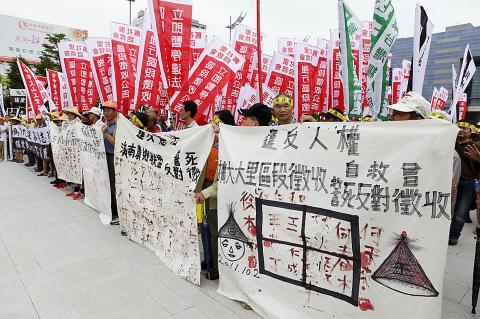
Photo: Chan Chao-yang, Taipei Times
The 193-hectare Wenshan Industrial District will leave farmers with no home and no jobs, Huang said.
People who own more than 1,620m2 of land are to be reimbursed with an equivalent plot of land at a separate location, while farmers are to receive about 40 percent of the size of their original land at another location, Huang said, as their original land, which is closer to the downtown area, would be seized by the government for a new residential zone, forcing them to relocate to more remote areas.
In addition, Huang said residents were worried that part of the industrial district would be designated as a Type A Industrial Zone, which could increase pollution in the area.
The government passed the responsibility of getting approval by the Environmental Protection Administration’s Environmental Impact Assessment to individual landowners, he said.
Taichung MRT Depot Expansion Zone Expropriation Self-Help Association chairperson Chao Chun-an (趙俊安) said hundreds of households would be uprooted as a result of government plans to expand the depot zone from 19 hectares to 85 hectares.
Shinan Self-Help Association chairperson Chang Huan-chang (張煥昌) said more than 10,000 people living in the 500 hectare area faced land expropriation for industrial use.
It is unfair for illegally built factories to become legal after the area is redesignated as an industrial zone, while small farmers will have no way to make a living because they have no resources or ability to establish factories, Chang said, adding that some residents who relied on loans would have no way to pay them back if they were forced to abandon their farms and houses.
The groups urged the central government to respect the residents’ rights to life and employment, as well as property protection as stipulated by the Constitution, and to amend the Land Expropriation Act (土地徵收條例) to avoid distortion of definitions of public benefit, which they say is often used as an excuse for land expropriation.
The groups also urged the city government to halt the land expropriation plans to protect agriculture in Taiwan, adding that food self-sufficiency and environmental protection are becoming increasingly important.

UPGRADE: The Kang Ding-class frigate is replacing its Chaparall missiles with Tien Chien II and Hua Yang VLS, which would provide it with long-range, 360° air defense Taiwan plans to produce 1,200 to 1,376 Hai Chien II missiles (海劍二, Sea Sword II) — also known as TC-2N — to serve as the standard air defense system of the navy’s surface combatant fleet, a source said yesterday. Last week, the Hai Chien II, the naval version of the Tien Kung II missile (天劍二, Sky Sword II), completed a live-fire test in waters off the National Chungshan Institute of Science and Technology’s Jiupeng facility (九鵬) in Pingtung County’s Manjhou Township (滿州). The MIM72 Chaparral and other dated air defense missiles that currently arm Taiwanese ships have inadequate range to combat Chinese

REASONS FOR TRAVEL: An assistant professor said that proposed amendments to penalize drivers if they used drugs overseas would not deter people from traveling People who operate a motor vehicle under the influence of marijuana would have their driver’s license revoked, even if they used the substance while overseas, the Ministry of Transportation and Communications said yesterday, citing proposed amendments to the Road Traffic Management and Penalty Act (道路交通管理處罰條例). The amendments would also authorize the government to revoke the licenses of people determined to have used Category 1 or Category 2 narcotics, even if they were not operating a vehicle while under the influence of drugs, as well as ban them from taking the license test for three years, the ministry said. People aged 18 or

HEAVY WEATHER: Typhoon Jangmi is due to crash straight into the Ryukyus as airlines look to shift flights to larger aircraft or cancel flights to Okinawa entirely Taiwan’s international air carriers announced flight adjustments over the weekend as Typhoon Jangmi is forecast to hit the Ryukyu Islands today and tomorrow. The Central Weather Administration (CWA) upgraded Jangmi from a tropical storm to a typhoon at 8am yesterday, with the eye located 580km south of Naha city. It was moving north at 19kph. Today, China Airlines’ CI-120, CI-121, CI-122 and CI-123 flights between Taoyuan and Naha, Okinawa, have been canceled as well as CI-132 and CI-133 between Kaohsiung and Naha. EVA Air’s BR-112, BR-113, BR-186 and BR-185 flights between Taoyuan and Naha are also canceled. Low-cost carrier Tigerair Taiwan canceled IT-230,
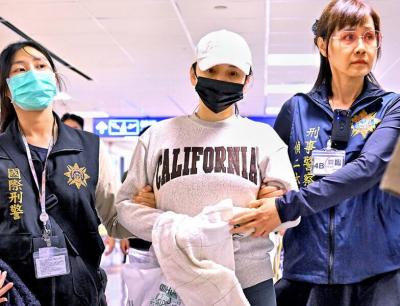
Johanne Liou (劉喬安), a Taiwanese woman who shot to unwanted fame during the Sunflower movement protests in 2014, returned to Taiwan last night after being deported from the US. She is to stand trial in Taiwan for charges involving embezzlement, fraud and drug crimes. The Criminal Investigation Bureau (CIB) said it took her into custody at Taiwan Taoyuan International Airport and would first question her before transferring her to the New Taipei District Prosecutors’ Office. She was arrested upon disembarking a flight from San Francisco that landed shortly before 7pm. Liou absconded to the US in 2019 after jumping bail


 RSS
RSS